
Story

This smooth cup opens with aromas of nougat, dried cherry, and milk chocolate. We found notes of almond, semi-sweet chocolate, and cedar when sipped, with nougat-like sweetness and a pleasant pop of dried cherry acidity. The finish features cedar and cocoa powder.
Certified Organic by OCIA.
The Story
Imported by our friends at Royal Coffee.
"The KKGO cooperative has farmers throughout the highlands surrounding Sumatra’s Lake Tawar. We often get high-grade coffees from this group hailing from specific sub-regions and communities. This is a lighter and brighter lot than most, from Atu Lintang, a small area southwest of the lake and part of the vast Aceh Tengah Regency.
"Aceh (pronounced AH-CHEY) is the northernmost province of Sumatra. Its highland territory is considered to be the epicenter of one of the world’s most unique coffee terroirs. Coffee farms in this area are managed with the experience of many generations of cultivation, while also harmoniously woven into their surrounding tropical forests. The canopies are loud and fields are almost impenetrably thick with coffee plants, fruit trees, and vegetables, all of which are constantly flushing with new growth. Year-round mists and rain showers never cease, and nothing is ever still—including coffee ripening, which occurs ten months out of the year."
KKGO and the Gayo Identity
"Koperasi Kopi Gayo Organic (KKGO) is a cooperative of 1,358 farmers. Members average 1 hectare each and are spread across the hillsides of the Bener Meriah and Aceh Tengah Regencies, which together circle the immediate highland ranges north and south of Lake Tawar. The cooperative, along with many local industries in the region, identifies itself as 'Gayo,' after the Gayonese ethnic group which has long made Aceh their home, and which comprises a vast majority of farmer members. KKGO was founded in 2006 and currently mills and exports through nearby PT Ihtiyeri Keti Ara, a family-owned company with whom Royal has worked for the past 20 years."
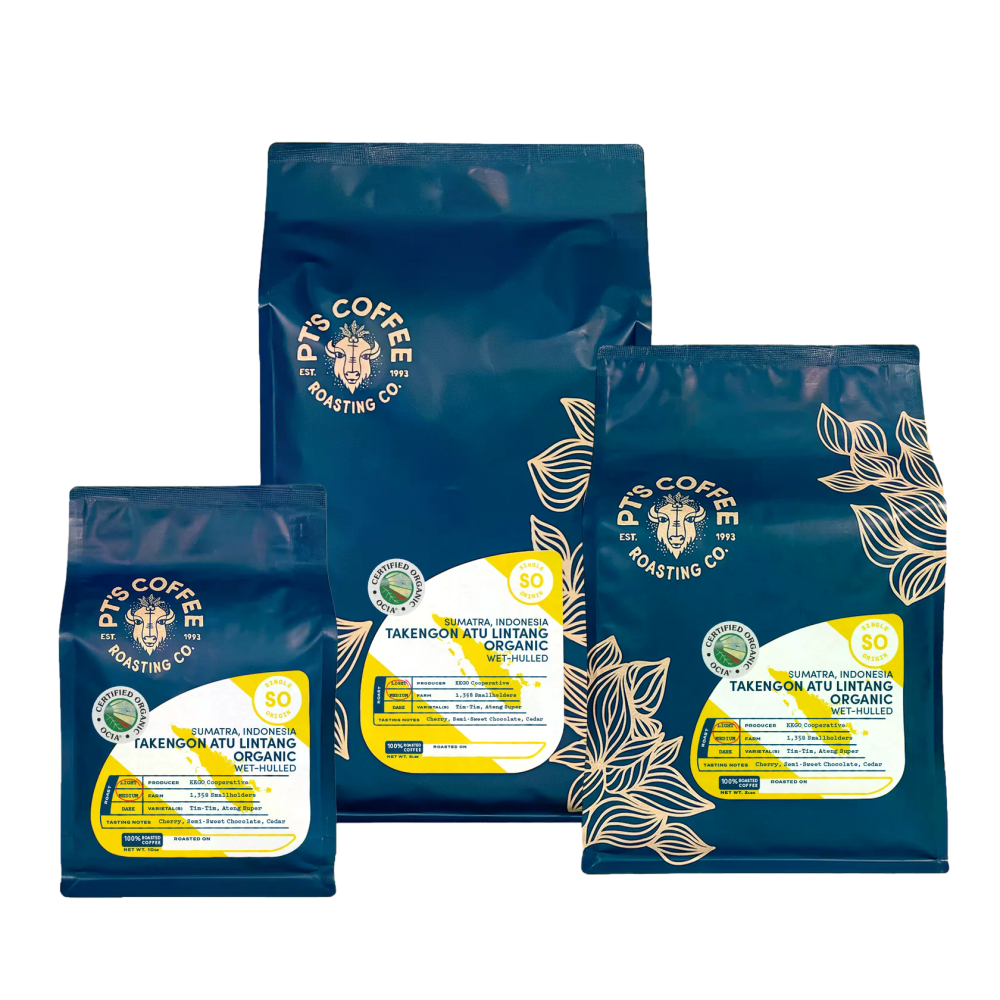
Sumatra Takengon Atu Lintang Organic
Sumatra Takengon Atu Lintang Organic
Couldn't load pickup availability
Characteristics
Medium Light
Round
Balanced
Cherry, Semi-Sweet Chocolate, Cedar
Koperasi Kopi Gayo Organic Cooperative
1,358 Smallholders
1,300 - 1,450 MASL
Tim-Tim, Ateng Super
Wet-Hulled
Aceh, Sumatra
Story
This smooth cup opens with aromas of nougat, dried cherry, and milk chocolate. We found notes of almond, semi-sweet chocolate, and cedar when sipped, with nougat-like sweetness and a pleasant pop of dried cherry acidity. The finish features cedar and cocoa powder.
Certified Organic by OCIA.
The Story
Imported by our friends at Royal Coffee.
"The KKGO cooperative has farmers throughout the highlands surrounding Sumatra’s Lake Tawar. We often get high-grade coffees from this group hailing from specific sub-regions and communities. This is a lighter and brighter lot than most, from Atu Lintang, a small area southwest of the lake and part of the vast Aceh Tengah Regency.
"Aceh (pronounced AH-CHEY) is the northernmost province of Sumatra. Its highland territory is considered to be the epicenter of one of the world’s most unique coffee terroirs. Coffee farms in this area are managed with the experience of many generations of cultivation, while also harmoniously woven into their surrounding tropical forests. The canopies are loud and fields are almost impenetrably thick with coffee plants, fruit trees, and vegetables, all of which are constantly flushing with new growth. Year-round mists and rain showers never cease, and nothing is ever still—including coffee ripening, which occurs ten months out of the year."
KKGO and the Gayo Identity
"Koperasi Kopi Gayo Organic (KKGO) is a cooperative of 1,358 farmers. Members average 1 hectare each and are spread across the hillsides of the Bener Meriah and Aceh Tengah Regencies, which together circle the immediate highland ranges north and south of Lake Tawar. The cooperative, along with many local industries in the region, identifies itself as 'Gayo,' after the Gayonese ethnic group which has long made Aceh their home, and which comprises a vast majority of farmer members. KKGO was founded in 2006 and currently mills and exports through nearby PT Ihtiyeri Keti Ara, a family-owned company with whom Royal has worked for the past 20 years."