
Story

This delicate coffee introduces itself with aromas of caramel, nectarine, cashew, and cocoa powder. Notes of milk chocolate, bergamot, and cashew accompany nectarine acidity in the round-bodied cup. Persimmon, black tea, and a touch of clove emerge in the finish.
Typica Mejorado is a genetically distinct line of Typica developed and propagated in Ecuador, possibly introduced through earlier experimental plantings by Ecuador’s national coffee research institute. Recent genetic testing by World Coffee Research has confirmed that it is a Bourbon by Ethiopian heirloom hybrid, which explains its floral, fruit-forward character with refined sweetness.
This was the first coffee variety planted at Hacienda La Papaya in 2009, using seeds sourced from an experimental farm in northern Ecuador, and to this day is the backbone of all three HLP farms. A batch of "mother plants" is maintained as a source of seeds for reproduction, with the aim of conserving the genetics of the variety.
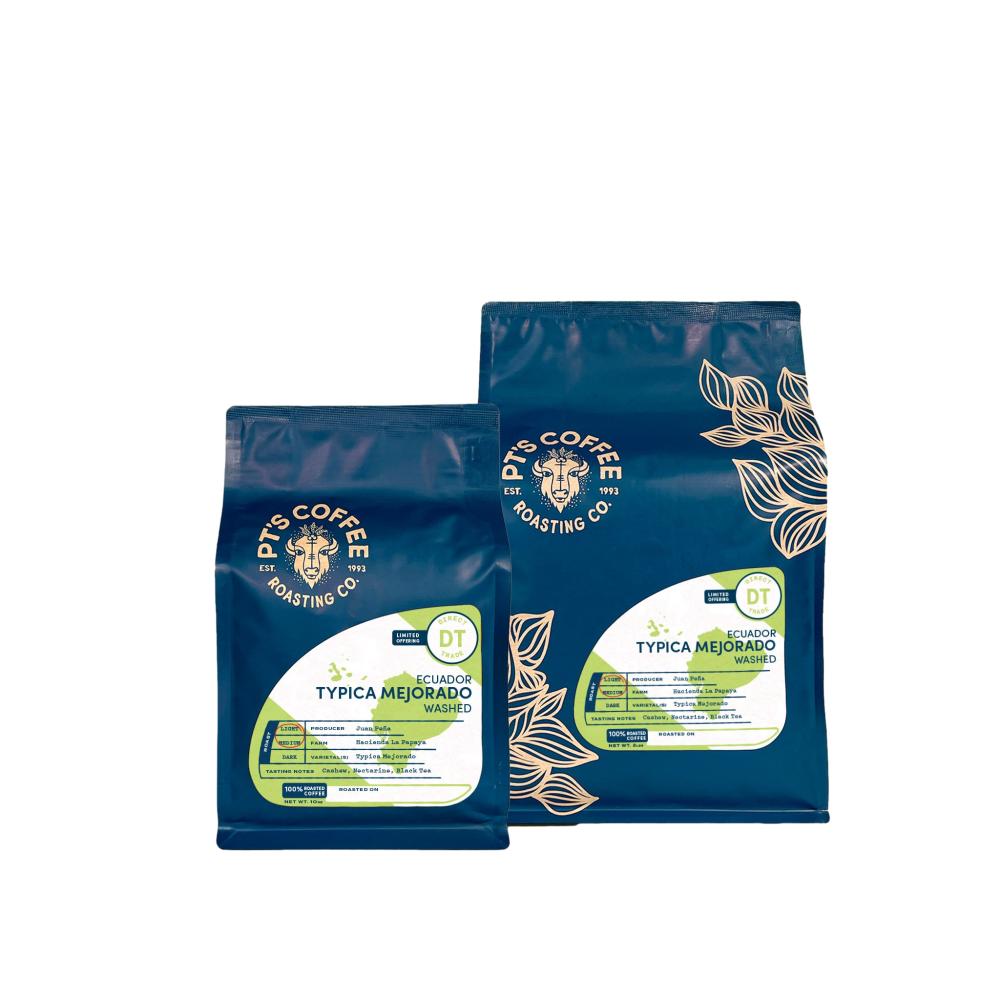
Ecuador | Hacienda La Papaya Typica Mejorado Washed
Ecuador | Hacienda La Papaya Typica Mejorado Washed
Couldn't load pickup availability
Characteristics
Medium Light
Round
Nectarine
Cashew, Nectarine, Black Tea
Hacienda La Papaya
Juan Pena
1800 - 2200 Masl
Typica Mejorado
Anaerobic Natural
Loja Province, Ecuador, South America
Story
This delicate coffee introduces itself with aromas of caramel, nectarine, cashew, and cocoa powder. Notes of milk chocolate, bergamot, and cashew accompany nectarine acidity in the round-bodied cup. Persimmon, black tea, and a touch of clove emerge in the finish.
Typica Mejorado is a genetically distinct line of Typica developed and propagated in Ecuador, possibly introduced through earlier experimental plantings by Ecuador’s national coffee research institute. Recent genetic testing by World Coffee Research has confirmed that it is a Bourbon by Ethiopian heirloom hybrid, which explains its floral, fruit-forward character with refined sweetness.
This was the first coffee variety planted at Hacienda La Papaya in 2009, using seeds sourced from an experimental farm in northern Ecuador, and to this day is the backbone of all three HLP farms. A batch of "mother plants" is maintained as a source of seeds for reproduction, with the aim of conserving the genetics of the variety.