
Story

Gachatha Coffee Factory rests on a 392-acre piece of land between the villages of Muthuaini, Thiriku, Gachenge, and Kianjau. It started in 1963 and its current members stand at 1,542. This super tasty washed coffee is grown by various smallholders at a ridiculous 1800-2100MASL.
The factory treats all wastewater in soaking pits to ensure no contaminates run into the local waterways, which are a source for drinking water. The community also places great importance on protecting the indigenous trees that remain in the area, so that the local bird life remains intact.
The main varieties of coffee grown here are SL-28, Batian, SL-34, and Ruiru-11. The region is rich with deep, fertile, well-drained red volcanic soils, ideal for coffee production.
The farms here are mostly very small (1-2 hectares) and adults work the farms while children attend school all day. Schools here cost money, which unfortunately limits access to education and future opportunities in this mostly-poor area. Due to lack of opportunity, much of the young population is migrating en masse to cities in search of better jobs, leaving their parents alone on the farms or even taking their parents and abandoning their farms. This problem gets worse each year, but some producers remain hopeful that coffee can provide good business opportunities for their children.
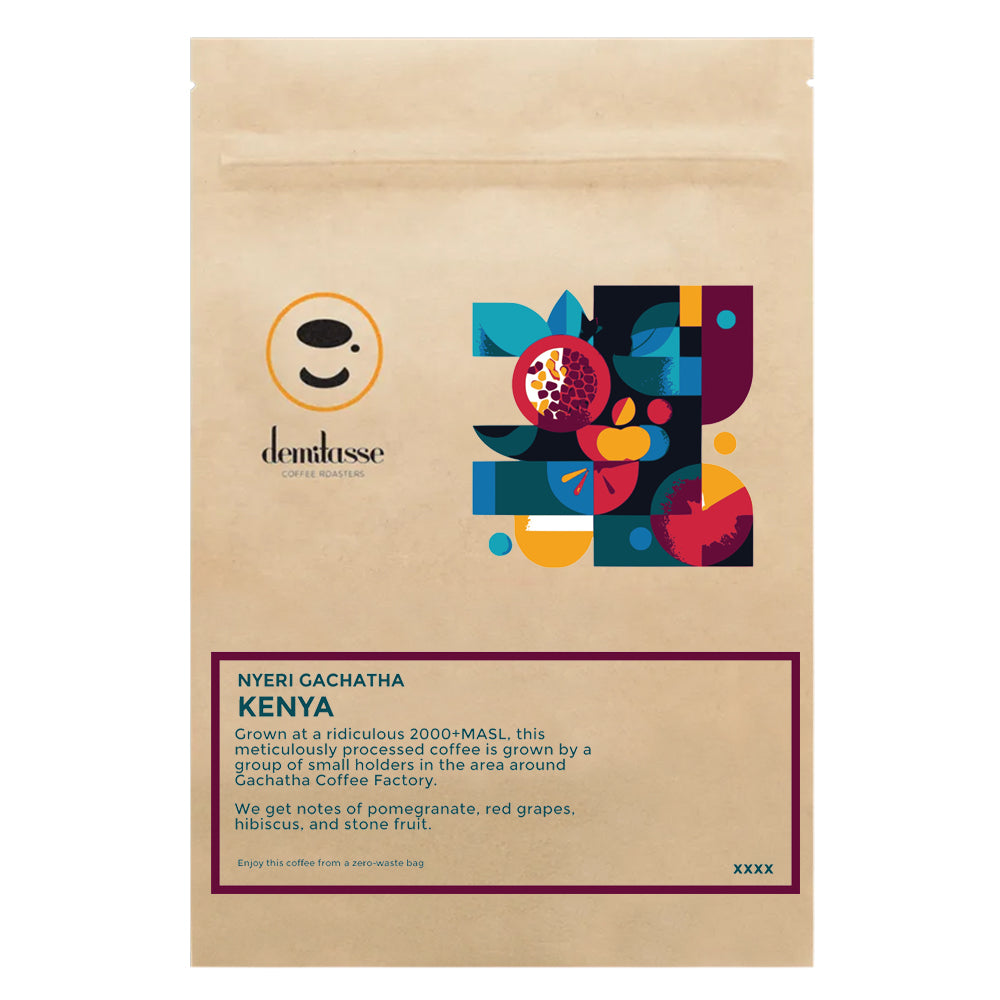
This is a wonderfully tasty coffee. We get notes of pomegranate, red grapes, hibiscus, stone fruit, grapefruit.
Kenya Nyeri Gachatha
Kenya Nyeri Gachatha
Couldn't load pickup availability
Characteristics
Light
Silky
Vibrant
Pomegranate, Red Grapes, Hibiscus, Stone Fruit, Grapefruit
Gachatha Coffee Factory
Various
1800 - 2100 MASL
SL-28, Batian, SL-34, and Ruiru-11
Washed
Between the villages of Muthuaini, Thiriku, Gachenge, and Kianjau
Story
Gachatha Coffee Factory rests on a 392-acre piece of land between the villages of Muthuaini, Thiriku, Gachenge, and Kianjau. It started in 1963 and its current members stand at 1,542. This super tasty washed coffee is grown by various smallholders at a ridiculous 1800-2100MASL.
The factory treats all wastewater in soaking pits to ensure no contaminates run into the local waterways, which are a source for drinking water. The community also places great importance on protecting the indigenous trees that remain in the area, so that the local bird life remains intact.
The main varieties of coffee grown here are SL-28, Batian, SL-34, and Ruiru-11. The region is rich with deep, fertile, well-drained red volcanic soils, ideal for coffee production.
The farms here are mostly very small (1-2 hectares) and adults work the farms while children attend school all day. Schools here cost money, which unfortunately limits access to education and future opportunities in this mostly-poor area. Due to lack of opportunity, much of the young population is migrating en masse to cities in search of better jobs, leaving their parents alone on the farms or even taking their parents and abandoning their farms. This problem gets worse each year, but some producers remain hopeful that coffee can provide good business opportunities for their children.
This is a wonderfully tasty coffee. We get notes of pomegranate, red grapes, hibiscus, stone fruit, grapefruit.