
Story

The Karogoto Factory, situated at an elevation of 1,708 meters above sea level in Nyeri County, Kenya, serves as the primary processing facility for the Tekangu Farmers Cooperative. As the cooperative’s largest producer, it processes cherries from approximately 1,800 smallholder farmers.
The name “Tekangu” is derived from the initials of three factories: Tegu, Karogoto, and Ngunguru. Farmers in the region cultivate varieties such as SL28, SL34, Batian, and Ruiru 11, taking advantage of the region’s fertile clay loam soil. The cooperative has its own agronomist who supports its farmer members by providing guidance on better agricultural practices and offering seedling coffee and native trees to ensure quality and sustainability.
Coffee cherries are picked by hand and delivered to the Karagoto factory, where they undergo a color selection process to ensure only ripe cherries proceed to the next step. The skin is then removed, and seeds are fermented with constant checks after a wash process in channels that remove light-density seeds and fermented mucilage (fruit flesh). Next, the coffee beans are slowly sun-dried in the rise African beds. Finally, a hand selection of the dry coffee seeds is done before the coffee is prepared for exportation.
The AA classification refers to the size of the coffee beans. Once the last protective layer of the coffee seed is removed, the beans are sorted using screens that are measured in 1/64 inch increments. AA beans are retained by a screen with a round perforation of 18/64 and 17/64 inches. Coffees in this classification receive premium prices.
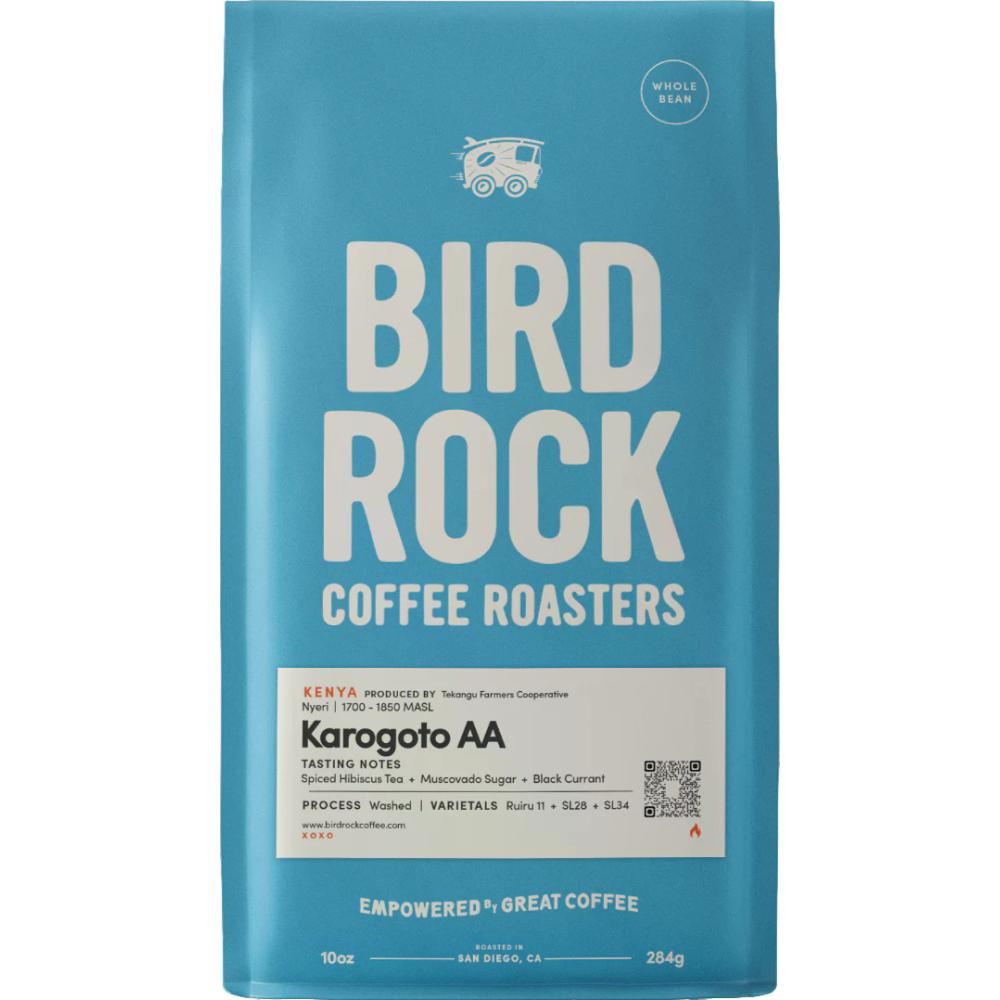
Kenya Karogoto AA
Kenya Karogoto AA
Couldn't load pickup availability
Characteristics
Light
Tea-like
Bright
Spiced Hibiscus Tea, Muscovado Sugar, Black Currant
Karogoto Factory
Tekangu Farmers Cooperative
1,700 - 1,850 MASL
Ruiru 11 + SL28 + SL34, Batian
Washed
Nyeri Region
Story
The Karogoto Factory, situated at an elevation of 1,708 meters above sea level in Nyeri County, Kenya, serves as the primary processing facility for the Tekangu Farmers Cooperative. As the cooperative’s largest producer, it processes cherries from approximately 1,800 smallholder farmers.
The name “Tekangu” is derived from the initials of three factories: Tegu, Karogoto, and Ngunguru. Farmers in the region cultivate varieties such as SL28, SL34, Batian, and Ruiru 11, taking advantage of the region’s fertile clay loam soil. The cooperative has its own agronomist who supports its farmer members by providing guidance on better agricultural practices and offering seedling coffee and native trees to ensure quality and sustainability.
Coffee cherries are picked by hand and delivered to the Karagoto factory, where they undergo a color selection process to ensure only ripe cherries proceed to the next step. The skin is then removed, and seeds are fermented with constant checks after a wash process in channels that remove light-density seeds and fermented mucilage (fruit flesh). Next, the coffee beans are slowly sun-dried in the rise African beds. Finally, a hand selection of the dry coffee seeds is done before the coffee is prepared for exportation.
The AA classification refers to the size of the coffee beans. Once the last protective layer of the coffee seed is removed, the beans are sorted using screens that are measured in 1/64 inch increments. AA beans are retained by a screen with a round perforation of 18/64 and 17/64 inches. Coffees in this classification receive premium prices.