

Story

This Lot Scored 93 Points from Coffee Review in 2023.
Coffee Reviews Blind Assessment:
“The coffee is well-balanced, bright, and has a deep, rich flavor. The aroma and cup offer notes of pomegranate, graham cracker, tangerine, baking chocolate, and cedar. The sweet-tart structure is lively and acidic, with a crisp and velvety mouthfeel. The finish consolidates to notes of tangerine and baking chocolate, with undertones of cedar.”
Finca El Socorro, a family-owned farm in the lineage of Juan Diego de la Cerda, has become synonymous with Specialty Coffee in Guatemala. Under Juan Diego’s leadership, the farm has achieved remarkable success, winning the prestigious Cup of Excellence in 2007, 2011, and again in 2020 with their Geisha variety. Throughout this period, the farm has consistently demonstrated exceptional performance in coffee competitions, often securing top five placements. If you’re savoring a cup of coffee from Finca El Socorro, you can be assured that you’re experiencing some of the finest coffee Guatemala has to offer.
Finca El Socorro, nestled near the town of Palencia in Guatemala’s Department, spans an impressive 700 hectares. Only 85 hectares are dedicated to coffee production, while a similar portion is allocated for dairy production. The remaining land is preserved as a nature reserve, safeguarding the habitat for migratory birds and regional species.
Finca El Socorro’s ideal altitude range, spanning from 1540 to 1860 meters above sea level, makes it an ideal location for cultivating dense, hard bean specialty coffee.
Juan Diego, a coffee enthusiast, is constantly seeking innovative ways to enhance and expand Finca El Socorro’s offerings. Renowned for their Bourbon, Java, Maracaturra, Pacamara, and Geisha varieties, Juan Diego also dedicates plots of land to exploring the potential of less established varieties at different altitudes on the farm. A prime example of this is his Purpurasea plot, where the coffee plants exhibit a unique phenotype expression, resulting in purple and dark green leaves and dark burgundy coffee cherries instead of the usual bright red.
All processing at Finca El Socorro is carried out on-site. However, processing at high altitudes presents challenges due to the fluctuations in temperature and humidity caused by hot days and damp nights. To overcome these obstacles, Juan Diego employs various drying techniques, including patio drying, shade drying, and periodic use of mechanical driers. Recently, he has constructed African-style raised beds on a separate site with ample wind and sunlight exposure. By controlling the drying coffee’s exposure to the elements using tarps, Juan Diego can adjust drying times accordingly.
The Purpurasea variety, a hybrid of the giant Maragogype bean and the traditional and sweet Caturra, is a productive plant but susceptible to leaf rust, necessitating careful monitoring. The unique characteristics of Maracaturra, combined with the dedication and expertise of the producers at Finca El Socorro, result in a delicate, flavorful, and sweet coffee.
Coffee cherries undergo several steps in processing and drying to achieve a stable moisture content. The most common methods include the natural process, honey process, and washed process.
Washed processing, a relatively recent method developed in Ethiopia in the 1950s, has gained widespread adoption in coffee-producing countries over the decades. Its consistent ability to produce high-quality coffee ensures producers receive the best possible prices for their beans.
The process begins with the careful sorting of freshly harvested coffee cherries. Initially, they are hand-sorted based on visual ripeness, followed by sorting by density. Cherries are placed in a channel of water, and under- or over-ripe ones float and are removed, while dense, ripe cherries sink to the bottom.
Next, the cherries move to a depulper, a machine that removes the coffee cherry’s skin and fruit. However, a thin layer of pulp, known as mucilage, remains attached to the outside of the coffee seed. To eliminate this mucilage, microbes in the environment are utilized through fermentation.
The coffee seeds are then transferred to tanks, usually filled with water, and allowed to ferment for a period of 12 to 36 hours. During this time, microbes break down the sugary mucilage, making it easier to remove. The duration of fermentation is influenced by temperature and other environmental factors.
Once fermentation is complete, the coffee seeds are rinsed again with water to remove the broken-down mucilage. They are then moved to patios or beds where they can be sun-dried, shade-dried, or a combination of both. Throughout this drying process, the coffee is turned to ensure even drying and continuously sorted to remove any defective or damaged seeds.
Drying is considered complete when the moisture content of the coffee reaches 10-12%. At this point, the coffee is collected, packaged, and prepared for export.
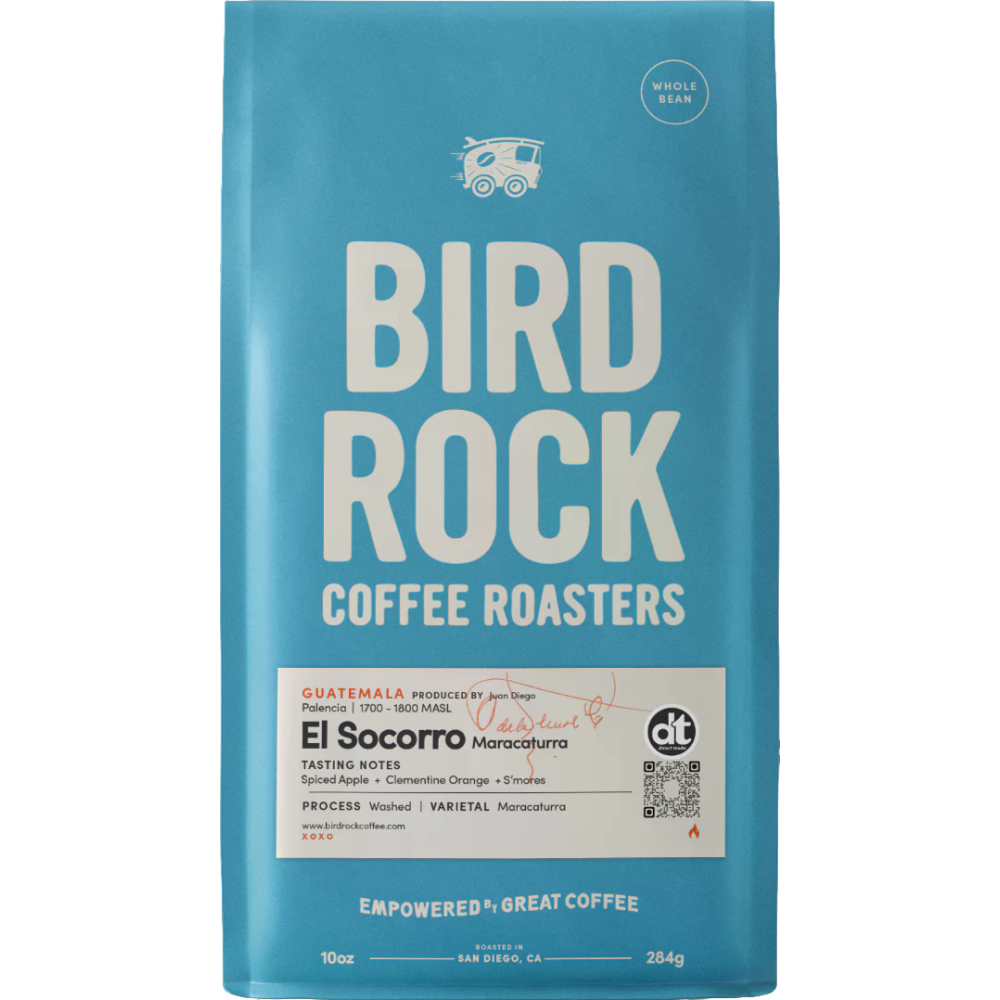
Guatemala El Socorro Maracaturra
Guatemala El Socorro Maracaturra
Rated 4.3 out of 5 stars
3
Regular price
$24.00 USD
Regular price
Sale price
$24.00 USD
Unit price
per
Couldn't load pickup availability
Shipping calculated at checkout.
Characteristics
Roast
Light
Body
Round
Acidity
Crisp
Notes
Spiced Apple, Clementine Orange, S'mores
Farm
Finca El Socorro
Farmer
Juan Diego De La Cerda
Elevation
1700 - 1800 Masl
Varietal
Maracaturra
Process
Washed
Location
Palencia, Guatemala
Story
This Lot Scored 93 Points from Coffee Review in 2023.
Coffee Reviews Blind Assessment:
“The coffee is well-balanced, bright, and has a deep, rich flavor. The aroma and cup offer notes of pomegranate, graham cracker, tangerine, baking chocolate, and cedar. The sweet-tart structure is lively and acidic, with a crisp and velvety mouthfeel. The finish consolidates to notes of tangerine and baking chocolate, with undertones of cedar.”
Finca El Socorro, a family-owned farm in the lineage of Juan Diego de la Cerda, has become synonymous with Specialty Coffee in Guatemala. Under Juan Diego’s leadership, the farm has achieved remarkable success, winning the prestigious Cup of Excellence in 2007, 2011, and again in 2020 with their Geisha variety. Throughout this period, the farm has consistently demonstrated exceptional performance in coffee competitions, often securing top five placements. If you’re savoring a cup of coffee from Finca El Socorro, you can be assured that you’re experiencing some of the finest coffee Guatemala has to offer.
Finca El Socorro, nestled near the town of Palencia in Guatemala’s Department, spans an impressive 700 hectares. Only 85 hectares are dedicated to coffee production, while a similar portion is allocated for dairy production. The remaining land is preserved as a nature reserve, safeguarding the habitat for migratory birds and regional species.
Finca El Socorro’s ideal altitude range, spanning from 1540 to 1860 meters above sea level, makes it an ideal location for cultivating dense, hard bean specialty coffee.
Juan Diego, a coffee enthusiast, is constantly seeking innovative ways to enhance and expand Finca El Socorro’s offerings. Renowned for their Bourbon, Java, Maracaturra, Pacamara, and Geisha varieties, Juan Diego also dedicates plots of land to exploring the potential of less established varieties at different altitudes on the farm. A prime example of this is his Purpurasea plot, where the coffee plants exhibit a unique phenotype expression, resulting in purple and dark green leaves and dark burgundy coffee cherries instead of the usual bright red.
All processing at Finca El Socorro is carried out on-site. However, processing at high altitudes presents challenges due to the fluctuations in temperature and humidity caused by hot days and damp nights. To overcome these obstacles, Juan Diego employs various drying techniques, including patio drying, shade drying, and periodic use of mechanical driers. Recently, he has constructed African-style raised beds on a separate site with ample wind and sunlight exposure. By controlling the drying coffee’s exposure to the elements using tarps, Juan Diego can adjust drying times accordingly.
The Purpurasea variety, a hybrid of the giant Maragogype bean and the traditional and sweet Caturra, is a productive plant but susceptible to leaf rust, necessitating careful monitoring. The unique characteristics of Maracaturra, combined with the dedication and expertise of the producers at Finca El Socorro, result in a delicate, flavorful, and sweet coffee.
Coffee cherries undergo several steps in processing and drying to achieve a stable moisture content. The most common methods include the natural process, honey process, and washed process.
Washed processing, a relatively recent method developed in Ethiopia in the 1950s, has gained widespread adoption in coffee-producing countries over the decades. Its consistent ability to produce high-quality coffee ensures producers receive the best possible prices for their beans.
The process begins with the careful sorting of freshly harvested coffee cherries. Initially, they are hand-sorted based on visual ripeness, followed by sorting by density. Cherries are placed in a channel of water, and under- or over-ripe ones float and are removed, while dense, ripe cherries sink to the bottom.
Next, the cherries move to a depulper, a machine that removes the coffee cherry’s skin and fruit. However, a thin layer of pulp, known as mucilage, remains attached to the outside of the coffee seed. To eliminate this mucilage, microbes in the environment are utilized through fermentation.
The coffee seeds are then transferred to tanks, usually filled with water, and allowed to ferment for a period of 12 to 36 hours. During this time, microbes break down the sugary mucilage, making it easier to remove. The duration of fermentation is influenced by temperature and other environmental factors.
Once fermentation is complete, the coffee seeds are rinsed again with water to remove the broken-down mucilage. They are then moved to patios or beds where they can be sun-dried, shade-dried, or a combination of both. Throughout this drying process, the coffee is turned to ensure even drying and continuously sorted to remove any defective or damaged seeds.
Drying is considered complete when the moisture content of the coffee reaches 10-12%. At this point, the coffee is collected, packaged, and prepared for export.

Awards:
Story: